



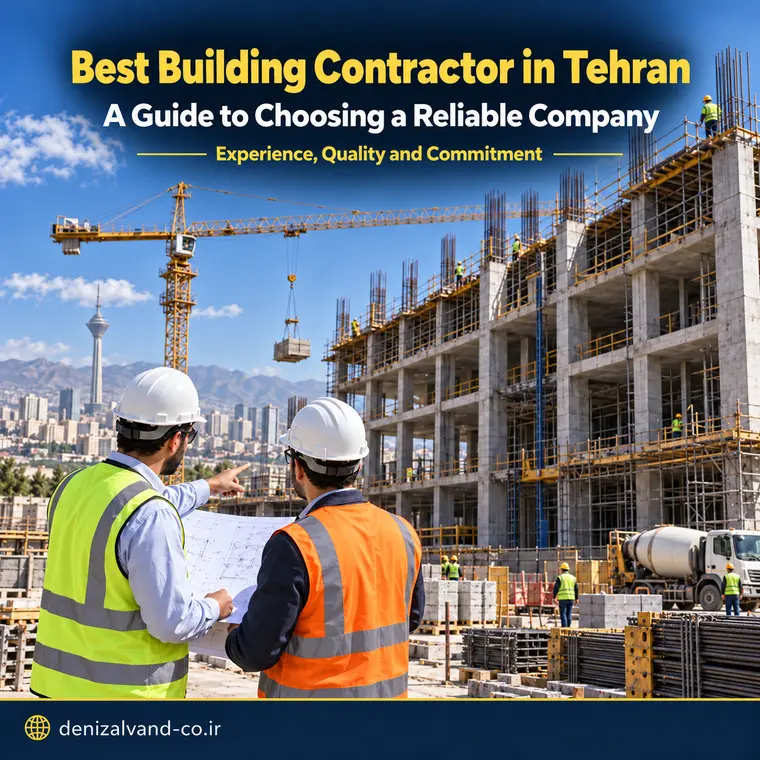
A Practical Guide for Property Owners and Developers
How to Choose the Best Building Contractor in Tehran
Choosing the best building contractor in Tehran can directly affect construction quality, project costs, completion time and long-term building performance. Before signing a contract, review the contractor’s technical experience, completed projects, cost proposal, project team and quality-control process. You can explore the company’s building contracting services or visit the Deniz Alvand Afagh website to learn more about its construction and civil engineering capabilities.
Finding a contractor is not difficult in a large city such as Tehran. The real challenge is identifying a contractor who can understand the technical requirements of the project, provide a realistic estimate, coordinate different construction teams and deliver the work according to the approved drawings and specifications.
Quick answer: The best building contracting company in Tehran is not necessarily the company offering the lowest price. It is the contractor with relevant experience, a qualified project team, transparent pricing, a realistic schedule and a reliable system for managing quality, safety and project changes.
What Makes a Building Contractor the Best Choice?
The word “best” does not have the same meaning for every construction project. A contractor may have extensive experience in residential buildings but lack the resources required for a large commercial development, an occupied office renovation or a government construction contract.
The right contractor must therefore be selected according to the type, scale, technical complexity and contractual requirements of the project.
A professional building contractor may be responsible for:
- Reviewing construction drawings and technical documents
- Planning construction activities and site operations
- Preparing the construction schedule
- Organising labour, equipment and subcontractors
- Purchasing and managing construction materials
- Coordinating structural, architectural and MEP activities
- Monitoring construction quality
- Preparing progress reports and payment statements
- Managing changes and additional work
- Completing inspections, defect correction and project handover
The exact responsibilities depend on the contract. For this reason, the contractor’s scope of work must be clearly defined before construction begins.
Why Is Contractor Selection Particularly Important in Tehran?
Construction projects in Tehran may face limitations that do not exist in smaller cities or less densely developed areas. Restricted access, heavy traffic, limited storage space, neighbouring buildings, working-hour limitations and complex material transportation can all affect project performance.
An experienced building contractor in Tehran should identify these constraints during the initial assessment and include them in the construction method, cost estimate and schedule.
Professional Contractor vs. Low-Cost Contractor
A low quotation can appear attractive, especially during the early stages of a project. However, the lowest initial price does not always produce the lowest final cost.
Important work items may be excluded from the quotation. Material quantities may be underestimated, or the proposed quality may not match the employer’s expectations. These issues can result in additional costs, delays and contractual disputes after construction begins.
A professional building contractor in Tehran should explain:
- What is included in the proposed price
- What is excluded from the contract
- Which materials and quality levels have been assumed
- How quantities will be measured
- How changes and additional work will be priced
- What risks may affect cost or completion time

10 Criteria for Choosing the Best Building Contractor in Tehran
1. Relevant Construction Experience
The number of years a contractor has been active is important, but relevant project experience is even more valuable.
A residential building, commercial complex, office project and structural rehabilitation project each require different resources and management skills. Ask the contractor to present completed projects that are similar to yours in terms of use, size, structural system and construction conditions.
A reliable contractor should be able to explain:
- The contractor’s actual role in each previous project
- The scope and value of the contract
- The project duration
- The main technical or operational challenges
- How those challenges were resolved
Project photographs alone are not sufficient evidence. References, contracts, completion records and the possibility of visiting a completed or active site can provide a more realistic picture of the contractor’s capabilities.
2. A Qualified Technical and Site Team
A construction project cannot be managed effectively without clearly assigned responsibilities. Depending on the size of the project, the contractor may need a project manager, site engineer, site supervisor, quantity surveyor, quality-control personnel, safety officer and specialised subcontractors.
Before selecting a contractor, ask the following questions:
- Who will be the main person responsible for the project?
- Will a site engineer be present during critical activities?
- Who will control construction quality?
- How will subcontractors be selected and supervised?
- Who will prepare progress reports and payment documents?
- Who will respond to the employer’s technical questions?
A reliable building contractor in Tehran should introduce the key team members before the contract is signed.
3. A Detailed Site and Document Review
A contractor should not provide a final quotation without understanding the project. Architectural, structural and MEP drawings must be reviewed together with the bill of quantities, technical specifications and existing site conditions.
The contractor should also evaluate:
- Site access and material delivery routes
- Available space for storage and site facilities
- The condition of neighbouring buildings
- Working-hour limitations
- Existing structural or architectural elements
- Temporary protection and stabilisation requirements
- Construction waste removal
- The availability of water and electricity
Site inspections are especially important for renovation, repair and structural strengthening projects. Read the guide to choosing a building contractor for building repair and structural retrofitting for more information about these projects.
4. A Clear and Measurable Contract
A professional construction contract should reduce ambiguity. Both the employer and the contractor must understand what will be completed, how quality will be assessed, when payments will be made and how changes will be handled.
The contract should clearly define:
- The complete scope of work
- Items excluded from the contractor’s responsibilities
- Drawings and technical documents forming part of the contract
- Material specifications and approved quality levels
- Contract price and payment schedule
- Measurement and valuation methods
- Project start and completion dates
- Procedures for variations and additional work
- Insurance and safety responsibilities
- Delay, suspension and extension-of-time conditions
- Temporary handover, defect correction and final handover
- Performance guarantees and dispute-resolution procedures
Verbal agreements concerning price, materials or scope should be documented before the related work is performed.
5. A Realistic Construction Schedule
A completion date is not a construction schedule. The contractor should prepare a programme identifying the sequence and duration of major activities.
The schedule should consider:
- Site mobilisation
- Material procurement and delivery
- Structural operations
- Architectural and finishing work
- MEP coordination
- Testing and inspections
- Employer or consultant approvals
- Defect correction and handover
An unrealistically short programme can be as problematic as an unnecessarily long one. The schedule must be based on the actual scope, available resources and site conditions.
6. Construction Quality Control
Material quality is only one part of quality management. Correct transportation, storage, installation and inspection are equally important.
A professional contractor should have a defined quality-control process that may include:
- Material approval before purchase
- Review of technical data sheets and samples
- Inspection checklists for critical operations
- Required material and construction tests
- Photographic records of concealed work
- Approval of each stage before subsequent work begins
- Defect identification and corrective actions
Quality records allow the employer and project consultant to verify that construction has been completed according to the approved specifications.
7. Cost and Change Management
Changes can occur even in well-planned projects. Drawings may be revised, the employer may select different materials or unexpected site conditions may be discovered.
The contractor should have a clear procedure for recording each change and assessing its effect on cost and time.
Before additional work begins, the following information should be confirmed:
- Description of the requested change
- Reason for the change
- Estimated quantities
- Unit rates or additional cost
- Effect on the construction programme
- Required employer or consultant approval
Uncontrolled variations are one of the most common causes of final-account disputes.
8. Site Safety and Organisation
Construction safety is not separate from project management. A disorganised site generally creates risks for quality, productivity and schedule performance as well.
The contractor should provide appropriate arrangements for:
- Personal protective equipment
- Safe access routes
- Protection of floor edges and openings
- Scaffolding and work-at-height operations
- Welding, cutting and hot-work control
- Electrical safety
- Material storage
- Waste collection and removal
- Emergency response
Safety responsibilities and insurance requirements should also be clearly defined in the contract.
9. Contractor Qualifications and Ranking
Some government, tender-based and large construction projects require a contractor with a valid qualification certificate or official ranking.
If you are looking for a qualified or ranked building contractor in Tehran, do not rely only on the statement that the company “has a ranking.” Review:
- The contractor’s approved field of activity
- The ranking category and grade
- The certificate’s validity date
- The company’s permitted project capacity
- Whether the qualification matches the tender requirements
For private projects where an official ranking may not be compulsory, company registration, technical resources, relevant experience, insurance coverage and contractual accountability should still be evaluated.
10. Communication and Reporting
Consistent communication helps prevent delayed decisions and misunderstandings. Before construction starts, the employer and contractor should agree on:
- The main point of contact for each party
- The frequency of coordination meetings
- The format of progress reports
- The process for submitting technical questions
- The person authorised to approve changes
- The method for recording instructions and decisions
A professional contractor should provide clear information about progress, delays, risks and required decisions rather than waiting until a problem becomes critical.
Choosing a Building Contractor for Different Project Types
The contractor’s experience and resources should match the intended use of the building.
Residential Building Contractor in Tehran
Residential projects require careful coordination between structural work, architectural details, MEP installations and finishing activities.
For a residential construction project, assess the contractor’s ability to manage:
- Structural construction
- Masonry and partitioning
- Waterproofing and insulation
- Flooring and wall finishes
- Doors, windows and façade work
- Electrical and mechanical coordination
- Common areas and external works
- Final inspections and handover
You can review the company’s residential construction services to learn more about this field.
Commercial Project Contractor in Tehran
Commercial projects often have strict completion deadlines, complex MEP requirements and detailed architectural finishes. Coordination between construction, façade, interior design, fire-safety systems and building services is particularly important.
If the property is partially operational, the contractor may also need to manage noise, dust, customer access and temporary protection.
Office Building Contractor in Tehran
Office construction and renovation projects require close attention to building services, workspaces, access control, lighting, network infrastructure and operational requirements.
When work is performed in an occupied building, construction activities must be planned to minimise disruption to employees and visitors.
Further information is available on the commercial and office construction page.
Government Building Contractor in Tehran
Government projects often involve formal tendering, detailed contract administration and specific documentation requirements.
A contractor working on government building projects should understand:
- Tender documents
- Contract conditions
- Schedules of rates
- Quantity measurement
- Interim payment statements
- Variation orders
- Official correspondence
- Inspection and handover procedures
Technical capability without adequate documentation and contract administration may not be sufficient for a government project.
Building Renovation Contractor in Tehran
Renovation projects differ from new construction because some conditions remain hidden until existing elements are opened or removed.
A renovation contractor should be able to inspect existing conditions, plan controlled demolition, protect retained elements and coordinate new work with existing structural and MEP systems.
Explore the building renovation services for further details.
Structural Retrofitting Contractor in Tehran
Structural retrofitting must be based on an engineering assessment and approved structural design. The contractor should have experience with the specified strengthening method and understand the importance of execution sequence and quality control.
Depending on the design, the work may include:
- Controlled demolition
- Concrete repair
- Crack repair and injection
- Rebar or anchor installation
- Concrete or steel jacketing
- Strengthening structural connections
- Installing new structural members
Steel Structure Contractor in Tehran
Steel structure projects require coordination between fabrication, transportation and site installation. Dimensional control, connection details, erection sequence and alignment must be managed carefully.
When assessing a contractor for steel structure construction, review its ability to control:
- Shop drawings
- Material certificates
- Fabrication dimensions
- Welding or bolted connections
- Transportation and lifting
- Erection sequence
- Column alignment and final geometry
More information is available on the steel structure construction page.
Building Contracting With or Without Materials
The appropriate contract model depends on the project documentation, the employer’s management resources, market conditions and the level of cost control required.
Building Contractor With Materials
Under this arrangement, the contractor is responsible for both construction and the supply of specified materials within the agreed scope.
This model can simplify coordination between procurement and site operations. However, the contract should define:
- Approved materials and technical specifications
- Acceptable brands or equivalent products
- Sample approval procedures
- Transportation and storage responsibilities
- Material price-adjustment conditions
- Ownership of unused materials
When comparing quotations from a building contractor with materials in Tehran, do not compare only the total price. Confirm that all contractors have priced the same materials, quantities and quality levels.
Labour-Only Building Contract
In a labour-only contract, the employer purchases the main materials and the contractor is responsible for execution.
This arrangement gives the employer more direct control over purchasing, but it also requires timely procurement. Late material deliveries can reduce labour productivity and delay the entire construction programme.
Construction Management Contract
Under a construction management or management-contracting arrangement, project costs are paid according to an agreed system, while the contractor or construction manager coordinates procurement, labour, subcontractors and site activities.
The management fee, purchasing procedures, approval limits and financial-reporting requirements must be defined before work begins.
Building Contractor Comparison Checklist
To compare building contractors in Tehran fairly, provide each company with the same drawings, scope of work, quality requirements and contractual assumptions.
| Evaluation Criterion | What to Review | Positive Indicator | Warning Sign |
|---|---|---|---|
| Relevant experience | Projects with similar use, scale and complexity | Verifiable project references | General claims without supporting records |
| Project team | Project manager, site engineer and specialists | Named personnel with defined responsibilities | No clear person responsible for the project |
| Technical proposal | Construction method and site planning | Project-specific execution approach | Generic proposal unrelated to site conditions |
| Cost proposal | Quantities, rates, assumptions and exclusions | Itemised and transparent quotation | Unexplained lump-sum price |
| Schedule | Activity sequence and procurement periods | Realistic and measurable programme | Completion promise without a detailed schedule |
| Quality control | Inspections, tests and documentation | Defined quality-control procedures | Dependence on informal visual checking |
| Safety | Site protection, PPE and safety responsibilities | Planned and documented safety measures | Unsafe or disorganised active sites |
| Contract terms | Scope, changes, payments and handover | Clear obligations for both parties | Important matters left to verbal agreement |
| Communication | Meetings, reports and decision management | Regular and documented communication | Late, incomplete or inconsistent responses |
Important: A contractor comparison is only meaningful when every proposal is based on the same scope. If one contractor has excluded waterproofing, temporary works, transportation or testing, its quotation cannot be compared directly with a complete proposal.

How Much Does Building Contracting Cost in Tehran?
There is no reliable fixed price for building contracting without reviewing the project. Construction costs depend on the scope, quantities, specifications, contract model and site conditions.
The main cost factors include:
- Total floor area and number of storeys
- New construction, completion, renovation or retrofitting
- Concrete or steel structural system
- Architectural and finishing quality
- Required material brands
- Complexity of structural and MEP work
- Site access and transportation limitations
- Storage and site-facility requirements
- Working restrictions in occupied buildings
- Project duration and required labour resources
- Responsibility for purchasing materials
- Completeness of construction drawings
- Potential changes during execution
Why Do Contractor Quotations Differ?
Two contractors may propose different prices because they have made different assumptions about the scope, materials, resources or risks.
Before selecting the lowest quotation, determine whether it includes:
- Site mobilisation and temporary facilities
- Material transportation and unloading
- Scaffolding and temporary protection
- Testing and inspection costs
- Waste removal
- Insurance and safety provisions
- Subcontractor costs
- Cleaning and final handover
A detailed quotation helps the employer understand what is being purchased and reduces the risk of additional costs during construction.
How to Request an Accurate Building Contracting Quotation
For an accurate building contractor quotation in Tehran, provide complete and consistent information.
The quotation package should include:
- Architectural drawings
- Structural drawings
- Mechanical and electrical drawings
- Bill of quantities, if available
- Technical specifications
- Project location
- Photographs of the existing site or building
- Required quality level
- Expected start and completion dates
- Preferred contract model
- Information about site access and working limitations
If drawings are incomplete, clearly state which items are still under design. The contractor should list all assumptions used in the estimate.
Questions to Ask Before Accepting a Quotation
Ask the contractor:
- Does the price include materials, labour or both?
- Are transportation and unloading included?
- Which items have been excluded?
- How long is the quotation valid?
- How will quantity changes be measured?
- How will additional work be priced?
- Does the price include testing and quality-control requirements?
- What payment schedule is proposed?
- What guarantees will be provided?
The Building Contracting Process: From Initial Review to Handover
Step 1: Initial Project Information
The contractor receives basic information about the project, including use, size, location, current condition, available drawings and the employer’s main objectives.
Step 2: Technical Site Inspection
The project team assesses site access, existing conditions, storage possibilities, neighbouring properties and operational restrictions.
Renovation and retrofitting projects may require additional investigations or structural-engineering input.
Step 3: Scope Definition
The employer and contractor identify the required activities, material responsibilities, quality levels, project boundaries and exclusions.
A clear scope is essential for accurate pricing and contractor comparison.
Step 4: Technical and Financial Proposal
The contractor prepares a proposal describing the construction approach, estimated duration, cost, payment conditions, assumptions and exclusions.
Step 5: Contract Agreement
Following technical and commercial negotiations, the contract documents, drawings, schedule and agreed proposal are finalised.
Step 6: Site Mobilisation
Temporary facilities, access arrangements, safety measures, storage areas and required equipment are established according to site conditions.
Step 7: Construction and Progress Control
Work is executed according to the approved documents. Progress, quality, costs, safety and changes are monitored throughout the project.
Step 8: Inspection and Defect Correction
Before handover, the completed work is inspected. Defects or incomplete items are recorded and corrected.
Step 9: Project Handover
The project is handed over according to the contract. Required documents, test results, records and outstanding obligations should be identified in the handover documentation.
Deniz Alvand Afagh: Building and Construction Services in Tehran
Deniz Alvand Afagh, operating under the Khakpour Contracting name, provides construction and building contracting services for residential, commercial, office and civil engineering projects.
A structured initial review helps property owners and developers understand the project scope, site limitations, required construction services and the information needed for a more reliable estimate.
To learn more about the company and its fields of activity, visit the About Us page. For questions regarding construction services, you can also use the Contact Us page.
Request an Initial Review of Your Construction Project
Send the available drawings, project specifications, photographs and location details so the initial scope and execution requirements can be reviewed.
Common Mistakes When Choosing a Building Contractor
Selecting a Contractor Only by the Lowest Price
A low quotation is useful only when it covers the same scope, quality and responsibilities as competing proposals. Missing items can significantly increase the final cost.
Starting Construction Without Complete Documents
Incomplete drawings and specifications increase the likelihood of changes and rework. If some design decisions remain open, the contract should define how they will be approved and priced.
Using a General Contract for a Specialised Project
A general residential contractor may not have the required resources for complex commercial, government or structural retrofitting work. Experience must match the project.
Paying an Unreasonable Advance
Payments should be connected to mobilisation, approved procurement or measurable construction progress. The payment schedule should support project cash flow while protecting both parties.
Ignoring Insurance and Safety Responsibilities
Insurance coverage, workforce obligations and responsibility for site incidents must be clearly defined before construction begins.
Accepting Verbal Agreements
Instructions affecting cost, quality, scope or completion time should be recorded and approved in writing.
Failing to Check Previous Projects
Do not rely only on photographs or a project list. Ask about the contractor’s actual role, contract scope, project duration and reference contacts.
Failing to Identify Excluded Work
Every proposal should include a clear list of exclusions. Work that appears obvious to the employer may not be included in the contractor’s price.
Frequently Asked Questions About Building Contractors in Tehran
How can I find the best building contractor in Tehran?
Start by identifying contractors with experience in projects similar to yours. Compare their technical teams, project references, proposed construction methods, itemised quotations, schedules, quality-control procedures and contract terms.
What documents should I request from a building contractor?
Request company registration documents, relevant project references, details of the proposed project team, insurance information and any qualifications or ranking certificates required for your project. The contractor should also provide a written technical and financial proposal.
Is a ranked building contractor necessary for every project?
A valid contractor ranking may be compulsory for certain government projects, tenders and formal contracts. It may not be mandatory for every private project, but technical capacity, relevant experience and legal accountability should still be verified.
How is the cost of building contracting in Tehran calculated?
The cost depends on quantities, specifications, structural system, finishing level, contract model, site conditions, schedule and material responsibilities. Drawings and site conditions must be reviewed before an accurate estimate can be prepared.
What information is needed for a construction quotation?
Provide drawings, project location, floor area, scope of work, photographs, required quality, expected schedule, site-access information and your preferred method of material procurement.
Should I select a building contractor with materials?
A contract with materials may be suitable when the employer does not have a dedicated procurement team. A labour-only contract provides greater purchasing control but requires the employer to deliver materials according to the construction schedule.
Can a building contractor perform renovation and structural retrofitting?
Yes, provided that the contractor has relevant experience and the work is performed according to an approved technical assessment and structural design. Specialised operations should not be assigned solely on the basis of general construction experience.
What should be included in a building construction contract?
The contract should include the scope, price, duration, payment method, material specifications, responsibilities, change procedure, insurance, safety obligations, guarantees, handover requirements and dispute-resolution process.
How many contractor quotations should I compare?
There is no fixed number, but comparing several qualified contractors is usually helpful. Every contractor should receive the same project information so that the proposals can be evaluated fairly.
Is the cheapest building contractor always the most economical choice?
No. The final cost can increase if important work items, quality requirements or temporary works are excluded. Compare scope, materials, schedule, quality controls and contractual responsibilities together with price.
Conclusion: Choose the Contractor That Fits the Project
Selecting the best building contracting company in Tehran requires more than comparing company names and total prices. The contractor’s experience must match the project, and its proposal must clearly explain how the work will be managed, controlled and delivered.
Before making a final decision:
- Define the project scope as accurately as possible
- Provide the same information to every contractor
- Review similar completed projects
- Meet the proposed project team
- Compare technical proposals as well as prices
- Identify every exclusion and assumption
- Confirm the construction schedule
- Document all contractual agreements
A well-structured contractor selection process reduces preventable delays, unexpected costs, quality problems and contractual disputes.
Do You Need a Contractor for a Project in Tehran?
Share your project information with Deniz Alvand Afagh for an initial review of the construction scope, technical requirements and proposed cooperation process.
No comments yet.