



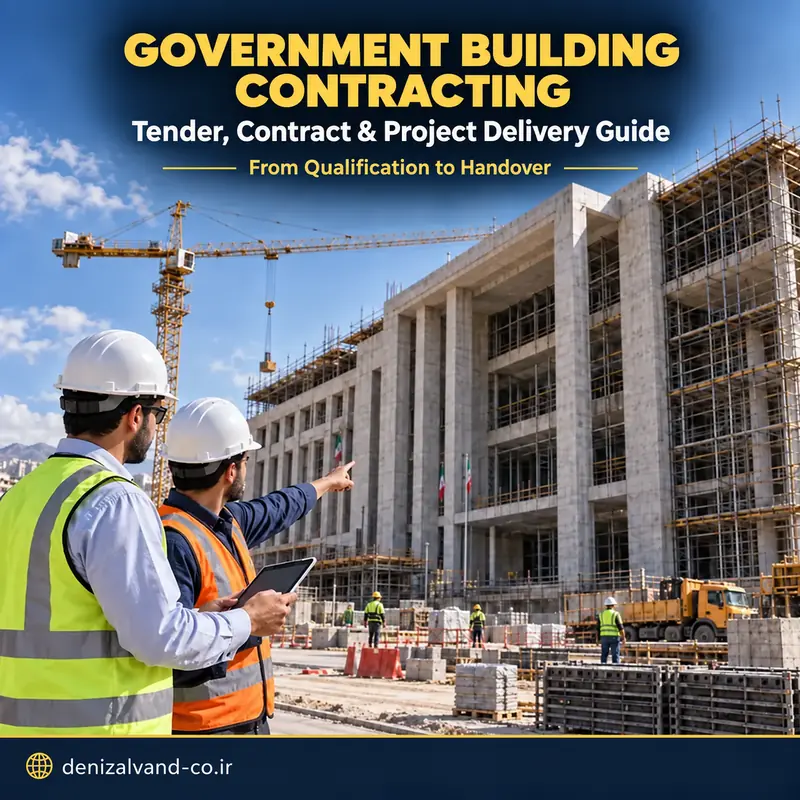
A Practical Guide for Public-Sector Clients and Project Owners
Government Building Contracting: A Complete Guide to Tenders, Contracts and Project Execution
In public-sector construction, selecting a contractor involves far more than comparing the lowest bid. Deniz Alvand Afagh evaluates each opportunity from both technical and operational perspectives, beginning with tender-document review and continuing through resource planning, construction control and handover. If your project involves the construction, completion, repair or improvement of a public building, understanding professional government building contracting services will help you define the scope, assess contractor capability and make better decisions about quality, schedule, cost and delivery. This guide explains the main requirements of public building projects and the issues that most directly affect successful execution.
Definition and Contractual Framework
What Is Government Building Contracting?
Government building contracting refers to the technical, managerial and construction services required to build, extend, complete, strengthen, repair or renovate buildings owned or commissioned by government bodies, municipalities, public companies and other public institutions. Depending on the tender documents, the contractor’s scope may cover one limited package—such as structural work, shell construction or finishing—or the complete delivery of a building together with associated services, external works and handover documentation.
Government building projects may involve masonry, reinforced concrete, structural steel, architectural finishes and related building works. However, the qualification category, contractor grade and specialist disciplines required for a particular tender must always be taken from that tender’s official documents. The word “building” in a tender title does not automatically mean that all mechanical systems, electrical installations, landscaping, infrastructure or equipment are included. The agreement, general and particular conditions, drawings, technical specifications, bill of quantities and tender instructions collectively define the contractor’s actual obligations.
Construction Scope and Services
What Services Does a Government Building Contractor Provide?
The exact scope of a public-sector construction contractor depends on the building type, existing site conditions, procurement method, design status and contract documents. A typical government building contract may include the following work packages:
01
Site Establishment and Demobilisation
Temporary facilities, fencing, site access, storage, protection measures, logistics routes, utilities and the project HSE plan.
02
Structural Construction
Excavation, foundations, reinforced concrete frames or steel structure fabrication and installation in accordance with approved drawings.
03
Shell and Core Works
Masonry, partitions, screeds, waterproofing, insulation, levelling, roof build-ups and other preparatory construction activities.
04
Architectural Finishes
Façades, stonework, tiling, plastering, painting, ceilings, doors, windows, joinery and detailed finishing works.
05
MEP Coordination
Coordinating building work with mechanical and electrical services, including openings, sleeves, risers and equipment interfaces.
06
Inspection and Handover
Material testing, quality records, as-built drawings, snagging, defect correction, close-out documents and formal handover.
Typical assignments include government office buildings, schools, healthcare facilities, public-service centres, cultural buildings, sports complexes, warehouses, industrial buildings and the completion of unfinished public projects. Where the scope covers several disciplines, coordination between building works and broader civil construction services becomes essential for controlling interfaces, access, levels, drainage and external works.
Comparing Procurement and Delivery Models
Government Building Contracts vs. Private Construction Projects
The fundamental engineering principles are similar in public and private construction. The main differences lie in procurement, formal approvals, payment procedures, change control and record keeping. The following table highlights the most important distinctions.
| Issue | Government Building Project | Private Construction Project |
|---|---|---|
| Contractor selection | Normally through a public tender, prequalification or another regulated procurement route | Direct negotiation, quotations or a limited competition selected by the client |
| Qualification | Required category, grade, capacity and evidence are stated in the invitation and tender documents | Usually based on experience, commercial terms and client-specific criteria |
| Commercial basis | Bill of quantities, schedules of rates, coefficients, measured work and certified interim payments | Lump sum, unit rate, construction management, labour-only or negotiated arrangements |
| Variations | Formal instructions, measurement records, approvals and contractual procedures are generally required | Managed under the private contract, often through a shorter approval route |
| Payment | Certified statements subject to contractual and statutory deductions | Paid according to the agreed milestone or payment schedule |
| Documentation | Formal correspondence, site records, test reports, minutes, instructions and as-built information | The documentation level depends on the contract and project-management system |
Consequently, a team with strong practical experience in building contracting in Tehran still needs disciplined technical-office procedures, document control, cash-flow planning, scheduling and formal correspondence before taking on a government construction contract. For a more detailed comparison of project scopes, read our guide to the difference between a building contractor and a civil contractor.
Eligibility, Capacity and Contractor Capability
Qualification Requirements for Government Building Contractors
A common question is: “What contractor grade is required for a government building tender?” There is no single answer that applies to every project. The contracting authority defines the relevant discipline, minimum grade, available capacity, work-value ceiling and, where applicable, similar-project experience or prequalification score. Before purchasing or submitting tender documents, every bidder should confirm that its current certificates and capacity satisfy the exact requirements of the opportunity.
Main Contractor Prequalification Criteria
- Valid qualification certificates and a discipline that corresponds with the tender scope;
- The required contractor grade and sufficient available capacity at bid and contract-award dates;
- Relevant project experience in terms of use, value, scale, technical complexity and delivery conditions;
- Financial strength, working capital and the ability to bridge the gap between expenditure and certified payments;
- A competent technical team, key personnel, plant, equipment and reliable supply resources;
- Evidence of satisfactory performance, quality, safety and handover on previous contracts;
- No legal restriction that prevents participation in the tender or award process.
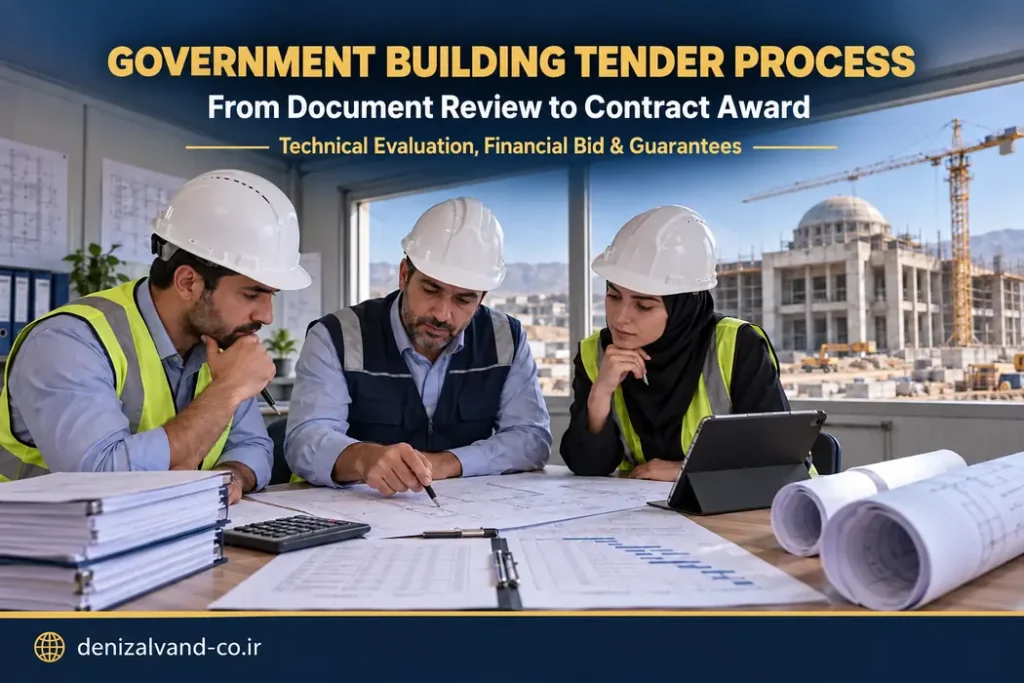
From Tender Notice to Contract Award
Government Building Construction Tender Process
The public building construction tender process must always be followed in accordance with the instructions issued for the specific procurement. Requirements vary between projects, but a typical process includes the following stages:
1
Review the Opportunity
Assess the project type, location, estimated value, duration, qualification category, minimum grade, deadlines and initial conditions.
2
Obtain and Study the Tender Documents
Read the tender instructions, drawings, specifications, contract conditions and bill of quantities as one coordinated set.
3
Attend the Site Visit
Evaluate access, neighbours, site-establishment space, existing conditions, operational restrictions, logistics and local supply risks.
4
Measure and Price the Works
Check quantities and calculate materials, labour, plant, waste, preliminaries, overheads, risk allowances and cash-flow requirements.
5
Prepare the Technical and Financial Proposal
Compile qualification evidence, the proposed team, method statements, preliminary programme, forms and pricing documents.
6
Provide the Bid Security and Submit
Verify the type, value, wording and validity of the security, then submit every required envelope or electronic file before the deadline.
7
Tender Evaluation
The authority evaluates legal, technical, qualitative and financial information using the method specified in the tender documents.
8
Contract Signing and Mobilisation
The successful bidder provides the required securities, insurance, plans and start-up documents before possession and mobilisation.
Do You Have a Government Building Project Ready for Review?
Send the project location, drawings, scope of work, bill of quantities and expected programme. We can review the available information and determine the appropriate technical evaluation and collaboration process. Every opportunity is considered after its scope and contractual requirements have been assessed.
Bid Compliance and Document Control
Documents Required for a Government Building Tender
The final tender checklist must be prepared directly from the issued instructions. Most required documents, however, fall into four broad groups:
| Document Group | Typical Documents | Critical Check |
|---|---|---|
| Legal and corporate | Registration documents, articles, authorised signatories, corporate IDs and necessary licences | Current validity, latest amendments and correct signatures |
| Qualification and capability | Certificates, capacity, similar experience, performance records, personnel and equipment | Exact alignment between the required and submitted discipline and grade |
| Technical | Method statement, project organisation, programme, quality plan and HSE plan | A realistic proposal suited to the site’s actual constraints |
| Financial and security | Priced offer, analyses, forms, declarations and bid guarantees | Correct value, wording, validity period and absence of inconsistencies |
Many proposals are rejected because of a seemingly minor but material omission involving a form, signature, stamp, guarantee, envelope or submission time. A final compliance review should therefore be performed by someone other than the person who originally assembled the bid. This independent check reduces the risk of losing an otherwise competitive tender for an administrative reason.
Obligations, Risk and Contract Documents
Government Building Contracts: Important Clauses and Guarantees
A government construction contract is not limited to a short signed agreement. The complete contract package defines the parties’ rights and obligations, measurement rules, payment procedures, variations, testing, delay provisions and handover requirements. The agreement, general conditions, particular conditions, technical specifications, drawings, schedule of rates, bill of quantities, programme and addenda must be reviewed together.
Issues That Must Be Clear Before Contract Signing
- Scope and responsibility boundaries: define precisely which party is responsible for building work, structure, MEP services, external works and supplied items;
- Contract price and payment: clarify measurement rules, interim statements, deductions, advance payment and supporting records;
- Time and programme: identify the commencement date, key milestones, critical path, excusable delay and extension-of-time procedure;
- Quantity changes and new work: state who may issue instructions, how new rates are determined and which records support valuation;
- Materials and equipment: establish procurement responsibility, sample and brand approval, storage, testing and acceptance requirements;
- Securities and retention: check bid security, performance security, advance-payment guarantee and defects obligations against the documents;
- Insurance, taxes and HSE: define responsibilities, deductions, statutory records and the applicable safety regime;
- Handover and defects period: specify provisional acceptance, snag correction, as-built records and final acceptance.
A clearly structured contract allows the construction team to spend less time interpreting responsibilities and more time managing the work. Where a public project contains complex architectural finishes or operational interfaces, experience in commercial and administrative construction can support work sequencing, detailed coordination and phased handover.
From Site Possession to Final Acceptance
Government Building Project Execution and Handover Process
1. Review the Design Basis and Establish the Site
After possession, the contractor verifies drawings, benchmarks, access routes, interfaces and existing conditions. Site offices, storage, temporary services, safety signage, protection measures, material routes and lifting zones should be planned before the main construction activities begin. An effective mobilisation plan reduces congestion, unsafe movement and repeated relocation of temporary facilities.
2. Prepare the Detailed Programme and Resource Plan
The construction programme should show activity relationships, labour and equipment resources, long-lead procurement and decision points requiring client input. A programme prepared only for administrative submission is not a useful control tool. The project manager should regularly compare the updated programme with actual progress, identify constraints and issue credible recovery measures when required.
3. Execute Structural, Shell and Finishing Works
Construction must follow issued drawings, approved samples and technical specifications. Dimensions, levels, material quality, workmanship and coordination between trades should be inspected before any work is concealed. Early interface checks between ceilings, partitions, floors, façades and building services significantly reduce rework and protect the completion schedule.
4. Operate an Effective Technical Office
The project technical office manages measurement, interim payment statements, site minutes, instructions, correspondence, shop drawings, progress reports and variation records. In public construction, work that is not properly measured and documented may become difficult to certify, value or accept. Document control is therefore part of construction delivery, not an optional administrative activity.
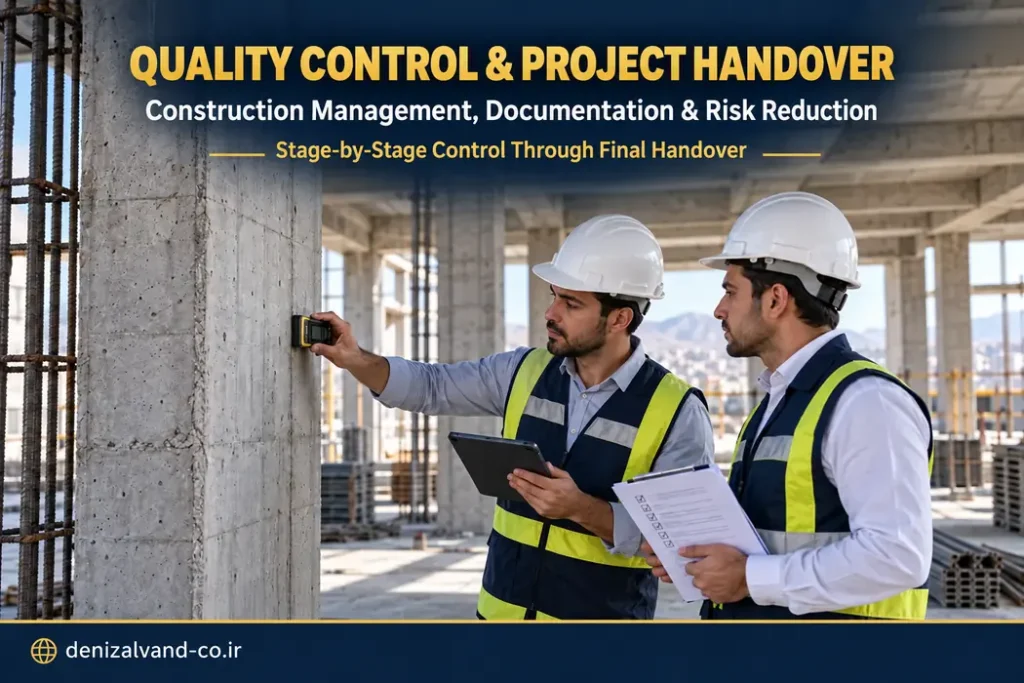
5. Implement QA/QC and HSE Controls
The inspection and test plan should define when each activity is inspected, who is responsible, what records are required and which acceptance criteria apply. Incoming-material approval, sampling, test results, hold points, release for subsequent work and management of nonconformities form the core of construction QA/QC. Workforce training, personal protective equipment, work-at-height control, excavation safety, housekeeping and traffic management must also operate as real site systems rather than paperwork.
6. Complete Provisional Handover, Defects and Final Acceptance
At completion, the parties prepare a snag list, correct defects and close outstanding records. Test certificates, approvals, minutes, warranties, operating documents and as-built drawings must be compiled for handover. A disciplined government building contractor does not wait until the final month to begin close-out; records should be indexed and archived as each part of the work is executed.
Estimating and Financial Proposals
How Is the Cost of a Government Building Project Calculated?
A search for the cost of government building construction cannot produce a reliable figure without project-specific information. A defensible tender price must be based on drawings, quantities, specifications, location, programme, procurement responsibilities and contract conditions. The main cost drivers include:
- The volume, complexity and diversity of structural, architectural, MEP and external works;
- The applicable base-year schedule of rates, work category, coefficients and price-adjustment rules;
- Haulage distances, restricted access, site logistics, accommodation and temporary-facility costs;
- The specified quality, brand, performance standard and testing requirements for materials and equipment;
- Project duration, restricted working hours and the need to keep an existing facility operational;
- Price volatility, payment timing and the working capital required to maintain progress;
- Testing, insurance, guarantees, retention, taxes, statutory deductions and project overheads;
- Design ambiguity, provisional quantities and identifiable contractual risks.
The lowest price is not always the most economical offer. An unrealistically low bid may later result in reduced progress, lower quality, cash-flow pressure, repeated claims or suspended work. Financial evaluation should therefore be considered alongside the proposed method, key staff, mobilisation capability, procurement plan and resource schedule.
Managing Construction Risk
Common Challenges in Public Building Projects and How to Control Them
01
Incomplete or Conflicting Drawings
Use coordinated design reviews, RFIs and interface checks before opening each work front.
02
Delayed Decisions and Approvals
Record decision deadlines in the programme and communicate their effect on the critical path early.
03
Price Volatility and Material Supply
Maintain a procurement schedule, approve samples promptly and prioritise high-risk, long-lead items.
04
Changes in Scope
Obtain formal instructions and agree measurement, time and cost records before executing changed work.
05
Work in an Operating Facility
Use phased construction, dust and noise control, protected routes and controlled sectional handovers.
06
Incomplete or Abandoned Projects
Survey existing work, verify its quality and define responsibility boundaries before recommencing construction.
For repair work or the completion of an occupied building, building renovation and refurbishment must be planned around the existing structure, live operations, safe demolition sequences and phased access. A condition survey before pricing helps separate new obligations from defects or unfinished work inherited from a previous contractor.
Evidence-Based Contractor Selection
How to Select the Best Government Building Contractor
The phrase “best government building contractor” is meaningful only when the evaluation criteria reflect the project’s actual risks. A familiar company name or a low tender price cannot replace due diligence. Public-sector clients and tender committees should ask the following questions:
- Does the contractor’s qualification category, grade and available capacity meet the tender requirements?
- Can the bidder provide verifiable evidence of comparable projects and satisfactory performance?
- What relevant experience do the proposed project manager, site manager and technical-office lead have?
- Is the mobilisation, procurement and work-front strategy practical for the stated programme?
- How will the contractor manage QA/QC, HSE, records, variations and formal correspondence?
- Are the contractor’s financial resources and current commitments compatible with the new project?
- Is the proposed price supported by clear assumptions, realistic productivity and complete scope coverage?
- What reporting, progress-control and client-response procedures will operate after contract award?
To understand our delivery approach, visit the Deniz Alvand Afagh project portfolio. You can also learn more about the company, its services and the Khakpour Contracting Group on the About Us page.
Initial Project Assessment
What Information Is Needed to Review a Government Building Project?
Providing a clear initial information package allows the contractor to evaluate scope, risk, programme and resource needs more efficiently. Where available, include:
- The contracting authority or project owner and the precise project location;
- Building use, gross floor area, number of storeys and current construction status;
- The required services and the boundary between building work and other disciplines;
- Available architectural, structural, mechanical and electrical drawings;
- The bill of quantities, technical specifications and principal contract conditions;
- The intended duration, expected start date, milestones and timing restrictions;
- Site access, temporary-facility capacity and any requirement to maintain live operations;
- Material and equipment procurement responsibilities and expected quality standards.
Start Your Government Building Project with a Technical Review
If you need a construction team to build, complete, repair or deliver part of a public or institutional facility, send us the available project information. After reviewing the documents, we can discuss the scope, site visit and appropriate next steps.
Answers to Common Questions
Frequently Asked Questions About Government Building Contracting
What does a government building contractor do?
Depending on the contract scope, the contractor may establish the site, execute structural and architectural works, coordinate MEP interfaces, manage quality and safety, prepare construction records and hand over the completed building. The issued contract documents define the final scope.
What contractor grade is required for a public building tender?
The minimum category and grade are not identical across all tenders. The contracting authority specifies them in the tender notice and documents. Certificate validity, available capacity, permitted work value and similar-project experience may also be evaluated.
What is the difference between a building contractor and a civil contractor?
A building contractor primarily delivers structural and architectural components of buildings. A civil contractor may work across infrastructure, external works, roads, utilities and specialised structures. The exact distinction depends on the qualification category and project scope.
How is a government building project priced?
Pricing is based on drawings, measured quantities, applicable schedules of rates, coefficients, technical specifications, duration, location, procurement conditions, overheads and contractual risks. A reliable price cannot be prepared without sufficient project documents.
Can a contractor execute only one part of a government project?
Yes, where the procurement method and contract allow it. The package may be limited to structural steel, shell construction, finishes, façade work, external works or completion of an unfinished building. Interfaces and handover points must be clearly defined.
Which records are most important during a public building contract?
The programme, daily and periodic reports, meeting minutes, instructions, correspondence, test results, quality checklists, measurement records, interim payment statements and as-built drawings are among the most important project-control documents.
What should we send for an initial project review?
Start with the project location, building area, existing condition, required scope, available drawings, bill of quantities, expected duration and known construction restrictions. Following the initial review, additional document and site-visit requirements can be identified.
Government Building Contracting Guide
Conclusion
Government building project delivery requires an appropriate qualification, genuine site capability, disciplined technical-office procedures, financial analysis, quality management and a practical understanding of public-sector contracts. Contractor selection should go beyond bid-price comparison and consider delivery capacity, key personnel, procurement strategy, comparable experience and transparency of method.
A precise scope, coordinated tender documents and construction records created at the same time as the work are three important controls for reducing disputes and achieving an acceptable handover. To discuss a project, visit our Contact Us page or request a government building project review.
No comments yet.