




Building Contractor vs Civil Contractor: What Is the Difference?
Understanding the difference between a building contractor and a civil contractor is essential before defining the scope, budget, and delivery strategy of a construction project. Deniz Alvand Afagh (Khakpour Contracting) delivers building, structural steel, commercial, residential, and civil works based on project drawings, site conditions, technical specifications, schedule requirements, and clearly assigned responsibilities.
In simple terms, a building contractor focuses on constructing, completing, repairing, or renovating buildings and their architectural and structural components. A civil contractor usually works across a broader range of infrastructure and heavy construction activities, including earthworks, roads, drainage, retaining structures, utility networks, industrial sites, and public works. The two roles can overlap, especially when building work forms one package within a larger civil engineering project.
What Does a Building Contractor Do?
A building contractor is an individual or company responsible for executing all or part of a building project in accordance with approved drawings, specifications, quantities, quality requirements, and the agreed programme. Depending on the contract, the work may begin with site mobilisation and limited excavation and continue through foundations, concrete or steel structure, walls, roofing, waterproofing, façade work, interior finishes, coordinated building services, external works, snagging, and final handover.
The term is often used for residential, commercial, office, hospitality, institutional, and industrial buildings. A capable building contractor must coordinate architectural, structural, mechanical, and electrical information while controlling materials, workmanship, tolerances, safety, inspections, and sequencing. Building contracting is therefore not limited to masonry or finishing work. It is the integrated management of resources and technical activities required to turn design documents into a safe, functional, and complete building.
Typical building contractor services
- Site mobilisation, foundations, and structural construction
- Concrete frames, masonry, roofing, floors, and waterproofing
- Coordination of structural, architectural, and building services work
- Façades, internal finishes, fit-out, and external building works
- Building repair, refurbishment, renovation, and strengthening
- Quality control, measurement, progress reporting, snagging, and handover
What Does a Civil Contractor Do?
A civil contractor executes infrastructure and engineered works that may extend well beyond a single building footprint. The scope can include bulk excavation, grading, fill placement and compaction, roads, drainage, culverts, retaining walls, utility corridors, reinforced concrete structures, industrial foundations, channels, hardscape, and large external works. These projects often require survey control, geotechnical coordination, laboratory testing, heavy equipment, logistics planning, and interface management across several work fronts.
Civil construction projects are commonly more dependent on terrain, soil conditions, weather, haul routes, temporary access, existing utilities, and permits. Their progress is often measured through quantities such as excavation volume, fill, concrete, reinforcement, pipelines, or completed route length. A civil contractor must manage these production rates while maintaining safety, environmental controls, testing records, and compliance with engineering specifications.
Typical civil contractor services
- Bulk excavation, grading, earth filling, and ground preparation
- Access roads, pavements, kerbs, drainage, and site development
- Retaining walls, channels, culverts, and concrete infrastructure
- Water, wastewater, stormwater, and underground utility networks
- Infrastructure for industrial, commercial, and urban developments
- Coordination of multiple civil, structural, and building work packages
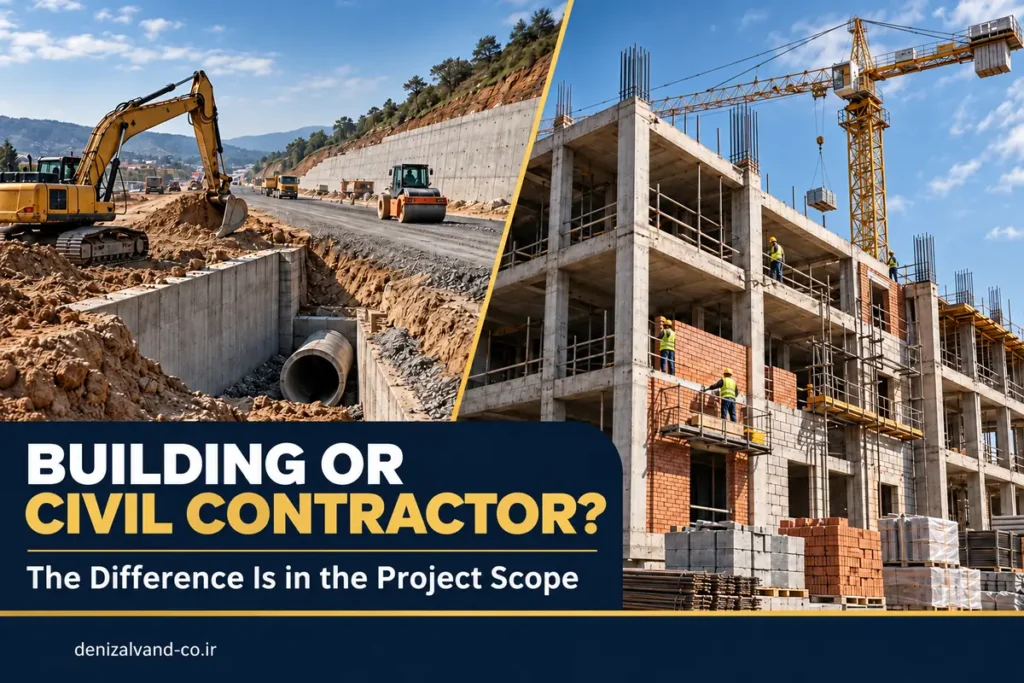
Building Contractor vs Civil Contractor
The following comparison explains the practical differences from a client’s perspective. The final responsibilities must always be defined by the drawings, specifications, bill of quantities, and contract conditions.
| Comparison | Building Contractor | Civil Contractor |
|---|---|---|
| Primary focus | Construction, completion, repair, and renovation of buildings | Infrastructure, site development, and large civil engineering works |
| Typical projects | Residential, commercial, office, industrial, and institutional buildings | Roads, utilities, drainage, retaining structures, industrial sites, and public works |
| Typical activities | Structural, architectural, masonry, façade, fit-out, and finishing works | Earthworks, concrete infrastructure, surveying, utilities, and heavy equipment operations |
| Usual scale | One building or a coordinated group of buildings | Large sites, routes, networks, or multiple work fronts |
| Key resources | Formwork, scaffolding, concrete, lifting, welding, and finishing resources | Excavators, loaders, haulage, compaction, survey, and infrastructure equipment |
| Primary deliverable | A completed building or defined building work package | Operational infrastructure or a site ready for further development |
| Overlap | May be delivered as part of a larger civil contract | May include one or more complete building packages |
Is a Building Contractor the Same as a General Contractor?
The terms are often used interchangeably, but they do not always describe the same contractual role. A building contractor may deliver a specific package such as the structure, masonry, envelope, finishes, or refurbishment. A general contractor usually accepts overall responsibility for coordinating most or all work packages required to complete the project. The general contractor may employ direct labour, appoint specialist subcontractors, or combine both approaches.
The contract is more important than the title. It should define design responsibilities, procurement, temporary works, builder’s work, coordination of services, materials supplied by each party, testing, approvals, variations, programme obligations, quality records, and handover documentation. To review completed work in relevant sectors, visit the Khakpour Contracting project portfolio and the English building contracting projects section.
Should You Hire a Building Contractor or a Civil Contractor?
Your project is building-led
If the principal deliverable is a residential, commercial, office, or industrial building—and most activities involve structure, architecture, services coordination, and finishes—a building contractor or building-focused general contractor is normally the better fit.
Your project is infrastructure-led
If the main work consists of bulk earthworks, roads, utilities, drainage, channels, retaining walls, or extensive external development, a civil contractor with suitable equipment and comparable experience is generally required.
Your project combines both scopes
Large commercial developments, industrial sites, and mixed-use projects often need both building and civil construction. In this case, select a contractor that can coordinate interfaces, control the master programme, and clearly assign responsibility across packages.
You are working on an existing building
For work within an occupied or existing property, experience in surveys, controlled demolition, temporary protection, strengthening, service coordination, and phased delivery is usually more important than access to heavy civil equipment. See our renovation and remodelling work.

Seven Criteria for Selecting the Right Contractor
- Relevant project experience: Review completed projects that are comparable in type, scale, construction method, constraints, and quality expectations.
- Technical and site team: Confirm who will act as project manager, site manager, engineer, supervisor, quantity surveyor, and safety representative.
- Resources and mobilisation: Evaluate the proposed labour, plant, temporary facilities, procurement plan, subcontractors, and mobilisation period.
- Realistic construction programme: The programme should show interfaces, critical activities, procurement lead times, inspections, milestones, and recovery options.
- Quality and HSE systems: Ask how materials, method statements, inspections, tests, non-conformities, and site safety will be managed and recorded.
- Transparent commercial proposal: Identify exclusions, provisional items, quantities, escalation assumptions, transport, waste, temporary works, and client-supplied materials.
- Clear contract scope: Define deliverables, payment rules, variations, delay responsibilities, warranties, completion criteria, and the defects correction process.
If the project includes a significant steel package, review the contractor’s capability in fabrication drawings, dimensional control, welding or bolted connections, transport, lifting, erection, and temporary stability. Deniz Alvand Afagh also provides steel structure design, fabrication, and installation services for conventional and special structures.
Common Mistakes When Appointing a Contractor
Selecting the lowest price without aligning the scope is one of the most expensive mistakes a client can make. A lower initial figure may exclude temporary works, testing, transport, equipment, protection, waste removal, coordination, or specific quality requirements. Comparing offers based on different assumptions creates a misleading commercial picture and increases the risk of variations and disputes after mobilisation.
Other common mistakes include starting without coordinated drawings, dividing packages without appointing an interface manager, failing to verify project-specific experience, and leaving measurement or variation rules undefined. Before tender comparison, every bidder should receive the same drawings, specifications, quantities, programme constraints, and contractual requirements. This makes building contractor costs and civil construction estimates more comparable and easier to control.
Working with Deniz Alvand Afagh
Project information review
We review the project type, location, scale, available drawings, existing conditions, target dates, and principal technical requirements.
Site and constraint assessment
Access, logistics, neighbouring properties, working space, safety requirements, utilities, and feasible work fronts are assessed.
Scope and execution proposal
Building and civil responsibilities, execution methods, procurement, programme, interfaces, and commercial basis are clarified.
Controlled delivery
Progress, quality, safety, coordination, inspections, records, and completion items are monitored throughout the works.
Building and Civil Contractor FAQs
What is the main difference between a building contractor and a civil contractor?
A building contractor primarily delivers buildings and their structural, architectural, and finishing components. A civil contractor generally handles infrastructure, external works, earthworks, utilities, and larger engineering packages. The exact difference depends on the project and contract scope.
Can a civil contractor construct buildings?
Yes. A civil contractor can deliver buildings when it has an experienced building team, appropriate resources, and relevant project history. Many civil projects include offices, service buildings, utility buildings, workshops, or other building packages.
Which contractor is suitable for a residential project?
A building contractor or general contractor with proven residential experience is usually the most suitable choice because the project requires close coordination of structural, architectural, services, and finishing work. Relevant examples are available in our residential construction portfolio.
How is the cost of building contracting calculated?
Cost depends on drawings, quantities, construction method, material standards, site access, procurement responsibility, programme, equipment, risk allocation, and contract type. A reliable proposal requires sufficient project information and, where appropriate, a site visit.
Can one company provide both building and civil construction services?
Yes. A contractor with multidisciplinary management, qualified technical teams, appropriate equipment, and relevant experience can deliver both scopes. Its actual capability should always be evaluated against the specific project requirements.
What information is needed for an initial contractor proposal?
Useful information includes architectural, structural, and services drawings; specifications or scope descriptions; quantities; site location; photographs of existing conditions; required material standards; target programme; and known access or operational constraints.
The Contractor’s Title Matters Less Than Its Proven Capability
The difference between a building contractor and a civil contractor lies mainly in project type, work scale, equipment, technical expertise, and contractual responsibility. Building contractors are typically best suited to constructing and completing buildings, while civil contractors are more closely associated with infrastructure and large multi-front operations. For combined developments, a contractor capable of coordinating both disciplines can reduce interface gaps, duplicated work, programme conflicts, and unclear responsibility.
Before making a decision, review relevant experience, the proposed project team, resource availability, delivery method, commercial assumptions, and quality controls. You can learn more about Deniz Alvand Afagh or explore our completed construction projects.
Send Your Project Information for an Initial Technical Review
Share the drawings, location, approximate scale, existing conditions, and target programme. Our team can review the building, civil, structural, and coordination requirements and help establish a clearer execution scope before contract award.
No comments yet.